

From boosting immunity to skin care, here are 10 powerful ways to incorporate Saudi Sidr honey into your daily wellness...
MADINA LAND · CULTURE & RECIPES
History, recipe, etiquette, health benefits, and everything you need to know about Saudi Arabia's most treasured drink.
_______________________________________________________________________________________________________________
Walk into almost any Saudi home announced or unannounced, at noon or midnight — and within minutes, something extraordinary will happen. A slender, curved pot will appear. A tray of small handleless cups will follow. And a warm, golden, cardamom-scented coffee will be poured for you before a single word of proper conversation begins.
This is Qahwa. And it is not simply coffee.
The word itself — قهوة — comes from an old Arabic root meaning to dull appetite, to energise. But in Saudi Arabia, Qahwa has grown into something far beyond the function of a caffeinated beverage. It's the language of welcome. It's how families say 'you matter here.' It's served at business negotiations, at wedding receptions, at the breaking of the Ramadan fast, and at the bedside of the sick.
In 2015, UNESCO recognised Arabic coffee and its associated hospitality culture as Intangible Cultural Heritage placing it in the same category as flamenco, the tango, and the Mediterranean diet. That designation says something important: this is not a drink you can fully understand just from a recipe.
This guide gives you both. The cultural story why Qahwa matters, what it means, how it's served and received and the practical recipe, so you can make an authentic cup at home and taste exactly what all of this is about.
| Note: This guide focuses specifically on Saudi Qahwa — the Gulf-style preparation using lightly roasted beans, saffron, and cardamom. This is distinct from Lebanese or Turkish coffee, which are different drinks with different techniques and flavour profiles. |
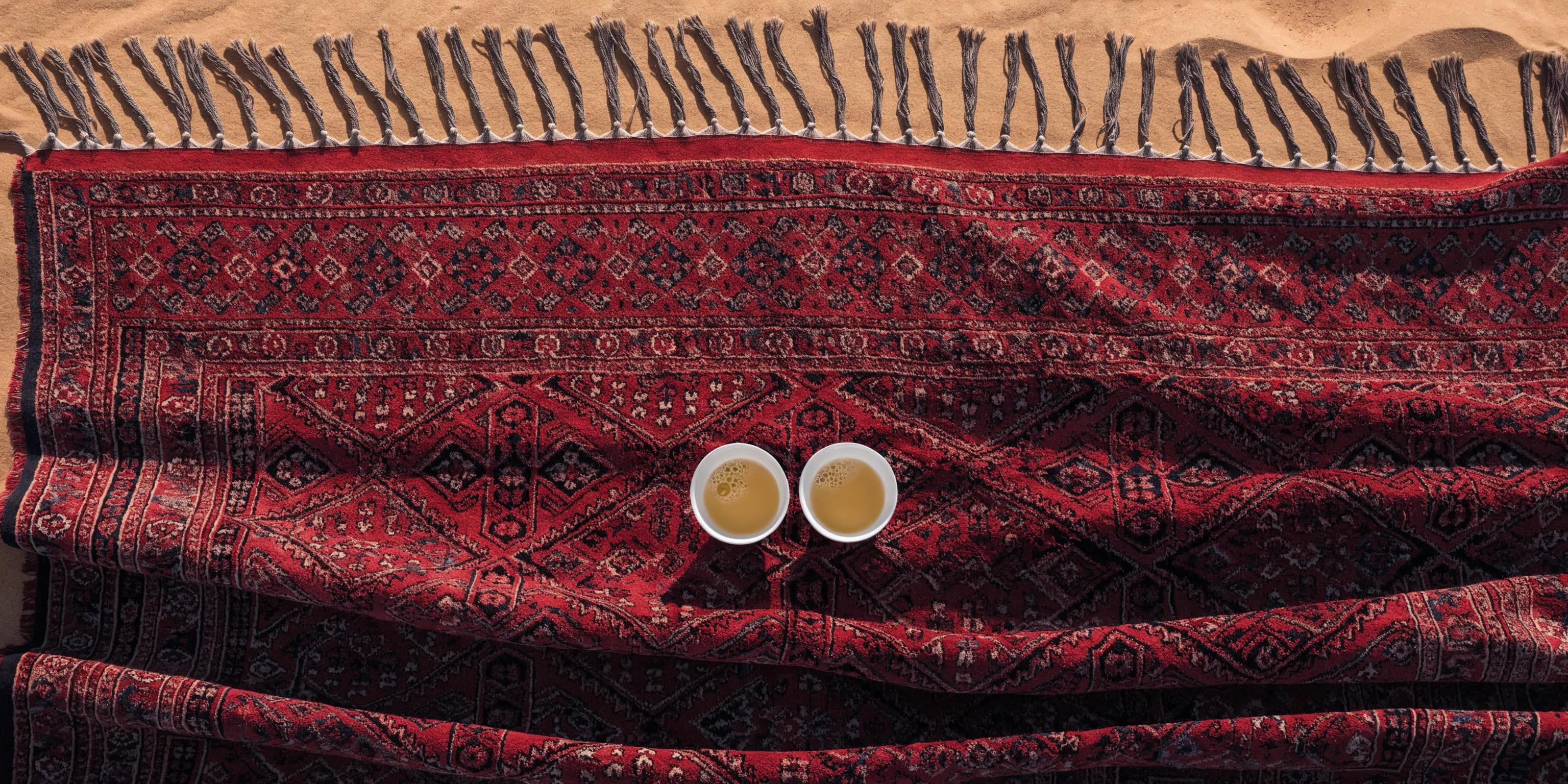
Qahwa (also spelled gahwa, or قهوة) is a lightly brewed, golden-coloured coffee made from barely-roasted green Arabica beans — steeped slowly in water with crushed cardamom, a thread of saffron, and sometimes cloves or rose water. It has a subtle, spiced warmth that is nothing like the dark, bitter coffee most people are familiar with.
The colour alone sets it apart. Where espresso is near-black and Turkish coffee is deep brown, Qahwa is a clear amber — almost translucent, like a tea. The roast on the beans is deliberately light, sometimes barely more than a warm-through, to preserve a delicate flavour that the spices can then build on rather than compete with.
It's served without milk. Usually without sugar. In small, handleless cups (called finjan or fenjan) that hold perhaps three sips each. You are not meant to gulp it. The whole culture around Qahwa is about slowing down — pouring slowly, drinking slowly, sitting together slowly.
And yet, despite its subtlety, it is genuinely distinctive. The first time most people try an authentic Saudi Qahwa, they describe it the same way: warm, floral, slightly earthy, with a gentle spice that lingers on the back of the tongue. It's an entirely different experience from anything called 'Arabic coffee' you might find in a western café.
This confuses a lot of people because the names get used interchangeably. Here's a clear breakdown:
Saudi Qahwa | Turkish Coffee | Western Espresso | |
| Bean roast | Very light / green | Dark | Very dark |
| Colour | Pale gold/amber | Deep brown | Near-black |
| Spices | Cardamom, saffron, cloves | Often plain | None |
| Sugar | Never (by tradition) | Often added in brewing | Optional |
| Texture | Clear, light | Thick, ground sediment | Thick crema |
| Cup size | Very small (3 sips) | Small with sediment | Espresso-sized |
| Cultural role | Hospitality ritual | Café culture | Daily routine |
Coffee's story starts in Ethiopia, where wild Arabica plants first grew in the highlands of the Kaffa region. But it was Yemen and the wider Arabian Peninsula that turned a fruit into a ceremony.
By the 15th century, Sufi monks in Yemen were brewing coffee to stay awake through nighttime prayers. The drink spread north along trade routes — first to Makkah and Madinah, then Cairo, Damascus, Istanbul. The world's first coffeehouses — qahwa houses — appeared in Makkah around 1511. At a time when the most sophisticated beverage Europe had was warm ale, the Arabian Peninsula had already built a sophisticated coffee culture with its own vessels, its own rituals, and its own social rules.
Saudi Arabia sits at the heart of this history. The region's coffeehouses were meeting points for scholars and merchants. The preparation of Qahwa was considered a skill worthy of respect, and a host who could brew a perfect cup was regarded as a generous and civilised person. This cultural weight didn't diminish over centuries — it deepened.
Today, Saudi Arabia consumes over 80,000 tonnes of coffee annually. Saudi Aramco employees drink it at meetings. Saudi airlines serve it in-flight as a mark of national identity. And in every Saudi home, the dallah — the distinctive long-spouted coffee pot — is as central to the kitchen as the stove.
| In 2015, UNESCO added Arabic coffee (Qahwa) and its hospitality traditions to the Intangible Cultural Heritage of Humanity list — the same recognition given to the Mediterranean diet, flamenco, and Japanese sake culture. It was inscribed specifically as a symbol of generosity and belonging in Arab societies. |
The Arab world spans 22 countries and three continents. Qahwa varies considerably from one region to the next, and knowing the differences tells you a lot about each culture's relationship with the drink.
The style we're focused on in this guide. Light roast beans, heavy cardamom, saffron, often a clove or two, sometimes rose water. Served without sugar, typically with dates on the side. The ritual of serving is itself an art form.
Similar to Saudi but often even lighter — almost pale yellow — and heavier on saffron. The spice ratio is more complex, with cardamom, cloves, and saffron all present at higher proportions. Still served without sugar.
Yemen is where coffee originated, and Yemeni Qahwa reflects that heritage. More complex spice profile — cardamom, ginger, cinnamon, nutmeg, cloves. Often uses Qishr (dried coffee husks brewed with ginger) rather than the bean itself. Rich in aroma, sharper in flavour.
This is what Lebanese food writers tend to describe when they write about 'Arabic coffee.' It's darker than Gulf Qahwa — closer to a medium roast — with cardamom as the primary spice. Still served in small cups, but the colour is brown rather than gold. Think of it as the halfway point between Saudi Qahwa and Turkish coffee.
Further still from the Gulf tradition. Spiced with ras el hanout, often much darker, and in some regions served with milk or argan oil. Recognisably different from Saudi Qahwa in almost every way.
| When a recipe or article calls something 'Arabic coffee' without specifying the regional style, it's almost always referring to a generic combination that doesn't represent any tradition accurately. Saudi Qahwa is a specific, distinct preparation — and that specificity is what makes it worth knowing. |
One of the most common mistakes people make when trying to make Qahwa at home is using regular dark-roast coffee. It will taste completely wrong. The distinctive golden colour and delicate spiced flavour of Qahwa depends entirely on using the right beans — barely roasted, almost green.
Saudi Qahwa is made from lightly roasted Arabica beans — so lightly roasted that they still retain a greenish-yellow colour. The technical term is 'blond roast' or simply green coffee. The beans are often ground coarsely (much coarser than espresso), because the brew needs to steep rather than force water through.
Many Saudi and Gulf markets sell pre-mixed Arabic coffee powder — ground light-roast beans already blended with cardamom. This is perfectly acceptable for home use and is exactly what most Saudi households use daily. Look for bags labelled 'Arabic coffee', 'Saudi coffee', or القهوة العربية.
Buy authentic Saudi Qahwa coffee blends from Madina Land
Cardamom is non-negotiable in Saudi Qahwa. It provides the floral, slightly citrusy warmth that defines the drink. Use whole green cardamom pods, cracked open and the seeds ground fresh — or ground cardamom if you don't have a mortar. The authentic ratio is generous: some Saudi recipes use nearly equal parts cardamom to coffee by volume, though most home cooks use somewhat less.
A few threads of saffron is what gives authentic Saudi Qahwa its characteristic golden hue and gentle floral flavour. It's not dominant — you shouldn't be able to taste it distinctly — but the coffee is subtly different without it. Use real saffron, not saffron powder or artificial coloring. Three to four threads per pot is enough.
A single whole clove (or half a clove) adds a faint warmth and depth. Don't use more than one — clove is powerful and will overwhelm everything else.
Added off the heat at the very end, a teaspoon of rose water lifts the whole brew with a delicate perfume note. It's the equivalent of finishing a dish with good quality salt — subtle but transformative. If you can find Saudi or Lebanese rose water rather than the concentrated Western baking versions, use that.
Filtered, cold water. Nothing more complicated. The flavour of Qahwa is delicate enough that heavily chlorinated tap water will affect it noticeably.
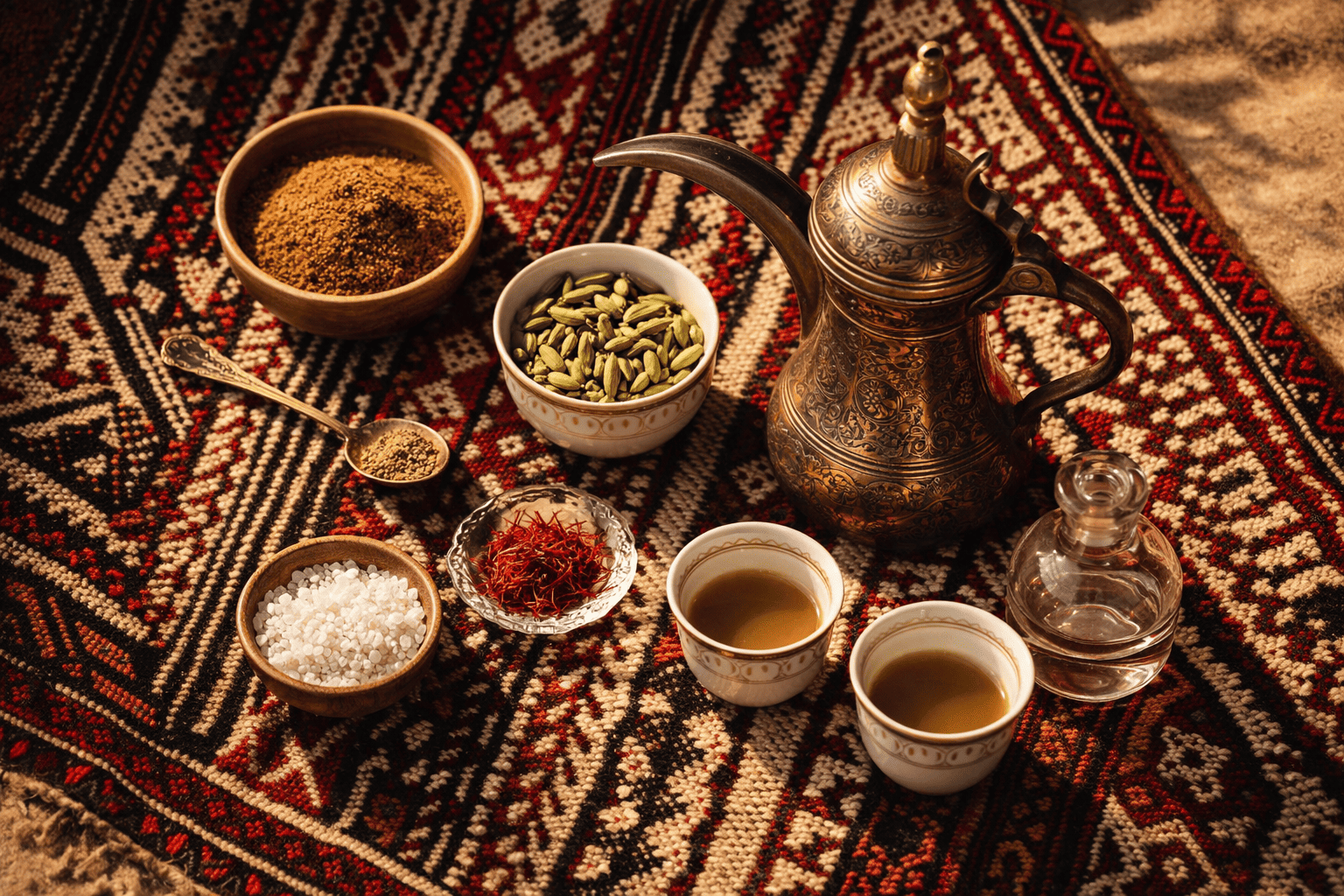
AUTHENTIC SAUDI QAHWA Serves 4–6 small cups · Prep: 3 mins · Cook: 15 mins · Total: 18 mins Ingredients
Method
Makes 4–6 servings · Calories per serving: ~8 kcal · No sugar, no milk, no compromise. |
If you can't find lightly roasted Arabic coffee in your local area, this workaround gets you close: Use a light-roast single-origin Ethiopian or Yemeni Arabica coffee (not medium or dark). Brew it weaker than you normally would, strain it into a pot with freshly crushed cardamom and a saffron thread, let it steep for 3 minutes, then add rose water before serving. It won't be identical to authentic Saudi Qahwa, but it will be far better than using regular supermarket coffee. As soon as you can, source the real ingredient — the difference is significant.
Never use a metal spoon to stir. Metal can react with cardamom and subtly affect flavour. Use a wooden spoon, or — for a lovely touch — stir with a cinnamon stick instead.
Grind your cardamom fresh. Pre-ground cardamom loses its aromatic oils within days. If you can, use whole pods: crack them, remove the seeds, grind in a small mortar. The difference in flavour is substantial.
Keep the simmer gentle. The single most common mistake. A hard boil agitates the grounds, makes the coffee bitter, and destroys the foam. Low and slow is the Saudi way.
Warm your serving pot before you pour. A cold dallah cools the coffee too quickly. Always warm it first with hot water.
Add the rose water off the heat. Rose water is volatile — heat destroys its fragrance. Add it after you've removed the pot from the stove, never while it's still over the flame.
Fill the cups only halfway. In Saudi tradition, Qahwa is served in small pours — never a full cup. This is both practical (keeps it hot) and cultural (signals the host will refill readily).
Use good dates. The pairing of Qahwa with dates isn't just a suggestion — it's an intentional flavour relationship. The natural caramel sweetness of a premium date like Khalas or Sukkari balances the gentle bitterness of the coffee in a way nothing else quite achieves.
Browse Madina Land's premium Saudi dates
This is the section most articles skip entirely — and it's one of the most important. Saudi hospitality has specific protocols around Qahwa that, once you know them, make the entire experience make more sense.
For anyone visiting Saudi Arabia, receiving a Saudi guest, or working with Saudi business partners, understanding these customs is both practically useful and a genuine sign of respect.
The dallah — Saudi Arabia's iconic long-spouted coffee pot, often made of brass or stainless steel — is not merely a vessel. It appears on the Saudi riyal. It's featured in contemporary Saudi art. The distinctive curved spout and angled handle are as recognisable a symbol of Saudi culture as the Green Dome of the Prophet's Mosque in Madinah.
The way the dallah is held matters: in the left hand, at a height that allows the coffee to arc slightly as it's poured. This isn't showmanship — the slight arc helps aerate the coffee and creates a thin layer of froth on the surface of each cup.
Qahwa is offered and received with the right hand. In Saudi and broader Islamic etiquette, the right hand is used for offering food and drink. As a guest, you receive the finjan with your right hand.
This is the custom most newcomers find confusing: when you've had enough Qahwa and don't want a refill, you gently tilt and shake your empty cup side to side as you return it. This signals to the host — wordlessly, politely — that you are satisfied. If you simply hand back the cup without shaking it, the host will refill it.
In a Saudi home, the most honoured guest receives the first cup. This isn't a formality — it's a genuine expression of the cultural value placed on hospitality and respect. Refusing the first offering of Qahwa is considered impolite unless there's a health reason (which is entirely understood).
Qahwa is not an on-the-go drink. Arriving at a Saudi meeting and being offered Qahwa is an invitation to be present — to sit, to drink slowly, to have a proper conversation before any business begins. The time between the first cup and the actual discussion is considered valuable, not wasted.
| A non-Saudi executive once told us that the Qahwa ritual at the start of a Saudi business meeting seemed like a delay. After several visits, he came to understand it differently: it's the time when trust is actually built. Everything that follows is easier because of it. |
Saudi Qahwa is brewed from lightly roasted beans, which means it retains higher levels of certain beneficial compounds than darker-roasted coffees. The spice additions — cardamom, saffron, clove — each bring their own documented properties.
Lightly roasted coffee is particularly high in chlorogenic acids — antioxidant compounds that are partly responsible for coffee's association with reduced risk of type 2 diabetes and certain metabolic conditions. Because Qahwa is brewed gently rather than forced through high pressure, these compounds are extracted without the harsh bitterness that can come with espresso.
Cardamom has a long history of use in traditional medicine across South Asia and the Middle East, and contemporary research supports several of these uses. It's been shown to have anti-inflammatory properties, and several studies suggest it may help with digestive discomfort, bloating, and nausea. The presence of cardamom in Qahwa is almost certainly one reason the drink is traditionally served after meals.
Saffron is one of the most studied natural mood-supporting substances in recent nutritional science. Meta-analyses of clinical trials have found it may have antidepressant properties comparable to some pharmaceutical interventions, albeit at higher doses than present in a cup of coffee. The amount in Qahwa is small, but the ritual context — warmth, company, slowing down — probably supports the mood benefit independently.
Traditional Saudi Qahwa contains no sugar and no milk. At roughly 5–10 calories per serving, it's one of the most naturally low-calorie hot drinks possible. This makes it compatible with most dietary approaches, including intermittent fasting protocols where most people want a flavourful drink without breaking a fast.
Cloves rank among the highest sources of antioxidants per gram of any food. A single clove in a pot of Qahwa adds a meaningful contribution to the total antioxidant content of the brew.
A practical note: Qahwa is still a caffeinated beverage. Drinking several cups in an evening will affect sleep for caffeine-sensitive individuals. Two to three small cups is the conventional daily amount in Saudi culture, and there's good sense behind that moderation.
In Saudi Arabia, Qahwa is almost never served alone. The tradition of pairing it with something sweet is deeply embedded in the culture — and it's not just habit. The light bitterness of the coffee and the natural sweetness of dates create a flavour pairing that is genuinely extraordinary together.
This is the correct starting point. A small bowl of fresh or semi-dried dates alongside a pot of Qahwa is the most traditional presentation. The varieties matter:
Khalas dates — caramel-rich and soft, the most popular pairing in the Eastern Province
Sukkari dates — buttery, honey-sweet, almost melt-in-the-mouth, from the Qassim region
Ajwa dates — the most revered date in Islam, from Madinah, darker and more complex in flavour
Medjool dates — large, moist, and sweet, excellent for guests unfamiliar with date varieties
Maamoul — shortbread-style cookies filled with dates, nuts, or semolina — are a celebratory accompaniment to Qahwa, particularly during Ramadan and Eid. Their slightly crumbly, buttery texture and sweet filling complement the spiced coffee beautifully.
A Saudi-specific biscuit flavoured with cardamom and sesame — effectively the taste of Gulf baking tradition in a small package. The cardamom in the biscuit mirrors the cardamom in the Qahwa, creating a pleasing resonance.
Lightly salted or plain pistachios, almonds, and cashews work well, particularly for Qahwa served without dates. The salt slightly accentuates the spice notes in the coffee.
It would be wrong to treat Qahwa as purely a historical tradition. It remains intensely present in contemporary Saudi life — but it has also evolved.
Saudi Arabia has one of the fastest-growing specialty coffee scenes in the world. Independent cafes in Riyadh and Jeddah now offer pour-overs made from single-origin Saudi-grown beans alongside traditional Qahwa. Saudi roasters are experimenting with blending heritage Arabic spice traditions with modern speciality coffee techniques. The Saudi Coffee Company (established under Vision 2030) is actively working to increase domestic production from the country's Jizan and Asir regions — mountains where conditions for Arabica cultivation are exceptional.
At the same time, the traditional role of Qahwa hasn't diminished. It's still served at the beginning of every formal gathering. Saudi weddings still feature a dedicated Qahwa corner. Corporate headquarters still maintain Qahwa stations. The Saudi government still serves it on Saudi Airlines as a deliberate marker of national identity.
There's something important in this persistence. The world is full of traditions that modernisation has displaced. Qahwa has survived — and arguably strengthened — because it meets a human need that modernity doesn't replace: the need to welcome people properly, to sit with them, and to offer them something warm from your own hands.
The quality of your Qahwa depends almost entirely on the quality of your ingredients — specifically the coffee and the dates. Both are worth sourcing carefully.
Authentic Saudi Arabic coffee blends — pre-ground lightly roasted beans with cardamom already mixed in — are increasingly available through specialist online retailers and Middle Eastern grocery stores. The brands to look for are ones that clearly state Saudi origin and use light or blond roast beans. Generic supermarket 'Arabic coffee' often uses darker roast beans that won't give you authentic Qahwa.
Madina Land sources and distributes authentic Saudi coffee blends and premium Saudi dates directly — the same varieties served in Saudi homes and sourced from the same regional farms. If you're looking for the ingredients that produce a genuinely authentic Qahwa experience, this is the most direct route.
What is Qahwa?
Qahwa (قهوة) is a traditional Saudi and Gulf Arabic coffee made from lightly roasted Arabica beans brewed with cardamom, saffron, and sometimes cloves or rose water. It is pale golden in colour, served in small handleless cups (finjan), and traditionally accompanied by dates. Unlike Western coffee, it is never served with milk or sugar. In 2015, UNESCO inscribed Arabic Qahwa and its associated hospitality culture on the Intangible Cultural Heritage of Humanity list.
How is Qahwa different from Turkish coffee?
They are fundamentally different drinks. Turkish coffee uses dark-roasted beans ground to an extremely fine powder, brewed in a small pot (cezve), and served with coffee grounds in the cup — thick, dark, and often sweet. Saudi Qahwa uses barely-roasted (green or blond) Arabica beans, brewed slowly with spices, then strained to produce a clear, pale golden liquid. The flavour, appearance, serving culture, and equipment are entirely different.
What coffee beans should I use for Qahwa?
Lightly roasted or green Arabica beans — you're looking for what's sometimes labelled 'Arabic coffee', 'Saudi coffee blend', or blond-roasted coffee. The beans should still have a greenish-yellow tinge. Standard medium or dark roast coffee will not produce authentic Qahwa — the flavour will be too harsh and the colour will be wrong. Pre-ground Saudi Arabic coffee blends with cardamom already added are widely available and produce excellent results.
Can I make Qahwa without a dallah?
Yes. A small saucepan for brewing and any heat-resistant pot or jug for serving works perfectly well. The dallah is the traditional vessel and serves a cultural purpose in formal settings, but for home brewing it's completely optional. The coffee tastes the same. If you're serving guests, using a beautiful teapot to present it can still create a meaningful presentation.
Why is Qahwa served without sugar?
In Saudi and Gulf tradition, the bitterness of the coffee is intentionally balanced by eating a date alongside it — not by adding sugar to the cup. The natural sweetness of the date and the gentle bitterness of the Qahwa create a deliberate flavour pairing. Adding sugar to the cup would disrupt this balance. That said, in some regions (parts of the Levant, for example), a small amount of sugar in the cup is accepted. Traditional Saudi Qahwa purists would consider it unnecessary.
What does Qahwa taste like?
Warm, delicate, slightly earthy, and gently spiced — with a floral quality from the cardamom and saffron. The flavour is subtle compared to Western coffee: there's no sharpness, no heaviness, no bitterness in the way dark-roast coffee is bitter. The overall impression is something between a lightly flavoured herbal tea and a gentle coffee, with the distinctive warmth of cardamom running through it.
Is Qahwa good for you?
Qahwa has several properties that research associates with health benefits: it's rich in antioxidants from the lightly roasted beans, cardamom has documented anti-inflammatory and digestive benefits, and saffron has been studied for its mood-supporting properties. The absence of sugar and milk keeps it very low in calories (roughly 5–10 per small cup). Like all caffeinated beverages, it should be enjoyed in moderation — 2–3 small cups per day is the traditional Saudi amount.
When should I serve Qahwa?
Qahwa is served in Saudi culture throughout the day but especially in three contexts: as a welcome drink for guests arriving at any time, during and after business meetings, and at celebratory gatherings including Ramadan Iftar, Eid visits, and weddings. It's not typically a breakfast drink in the Western sense — Saudi mornings more commonly feature tea or a quick coffee. Qahwa is the hospitality drink, served when receiving or visiting someone.
How do I tell my host I've had enough Qahwa?
Gently tilt and shake the empty finjan cup side to side as you return it. This is the traditional Saudi signal that you are satisfied and don't want a refill. Without the shake, the host will assume you'd like more and refill your cup. Knowing this custom prevents an inadvertent obligation to keep drinking, and shows cultural awareness that Saudi hosts genuinely appreciate.
What's the difference between Qahwa and gahwa?
Same drink, different transliterations. Arabic doesn't map perfectly to the Latin alphabet, so the same word (قهوة) appears as Qahwa, gahwa, ghawa, kahwa, or kahva depending on the regional accent and the person doing the transliterating. You'll see all these spellings used interchangeably online. If a recipe calls for any of these, it's referring to the same tradition.
Qahwa is one of those things that sounds simple on paper — lightly roasted beans, a bit of cardamom, some water — but produces an experience that's genuinely difficult to describe until you've had it in the right setting.
If you make this recipe, serve it in the smallest cups you have, drink it slowly, and if at all possible share it with someone. The whole point of Qahwa is that it's a drink for two or more people. That's baked into the tradition at the deepest level. Every element of it, the small cups that require refilling, the time spent waiting for the pot to simmer, the dates arranged on the side exists to create a moment of undivided shared attention.
In a world of two-minute espressos and coffee consumed on the commute, that's worth experiencing at least once.
Ready to brew authentic Qahwa at home? Madina Land supplies premium Saudi Arabic coffee blends and the finest Saudi dates — the same ingredients used in Saudi homes every day, now available internationally. |
Share:
From boosting immunity to skin care, here are 10 powerful ways to incorporate Saudi Sidr honey into your daily wellness...
Ten Saudi-origin superfoods nutritionists and health buyers seek worldwide. From Ajwa dates to black seed and Talbina, d...
Following are the 10 remarkable benefits of Ajwa dates: (1) Rich in antioxidants, (2) Support heart health, (3) Boost im...